- Posted on
- admin
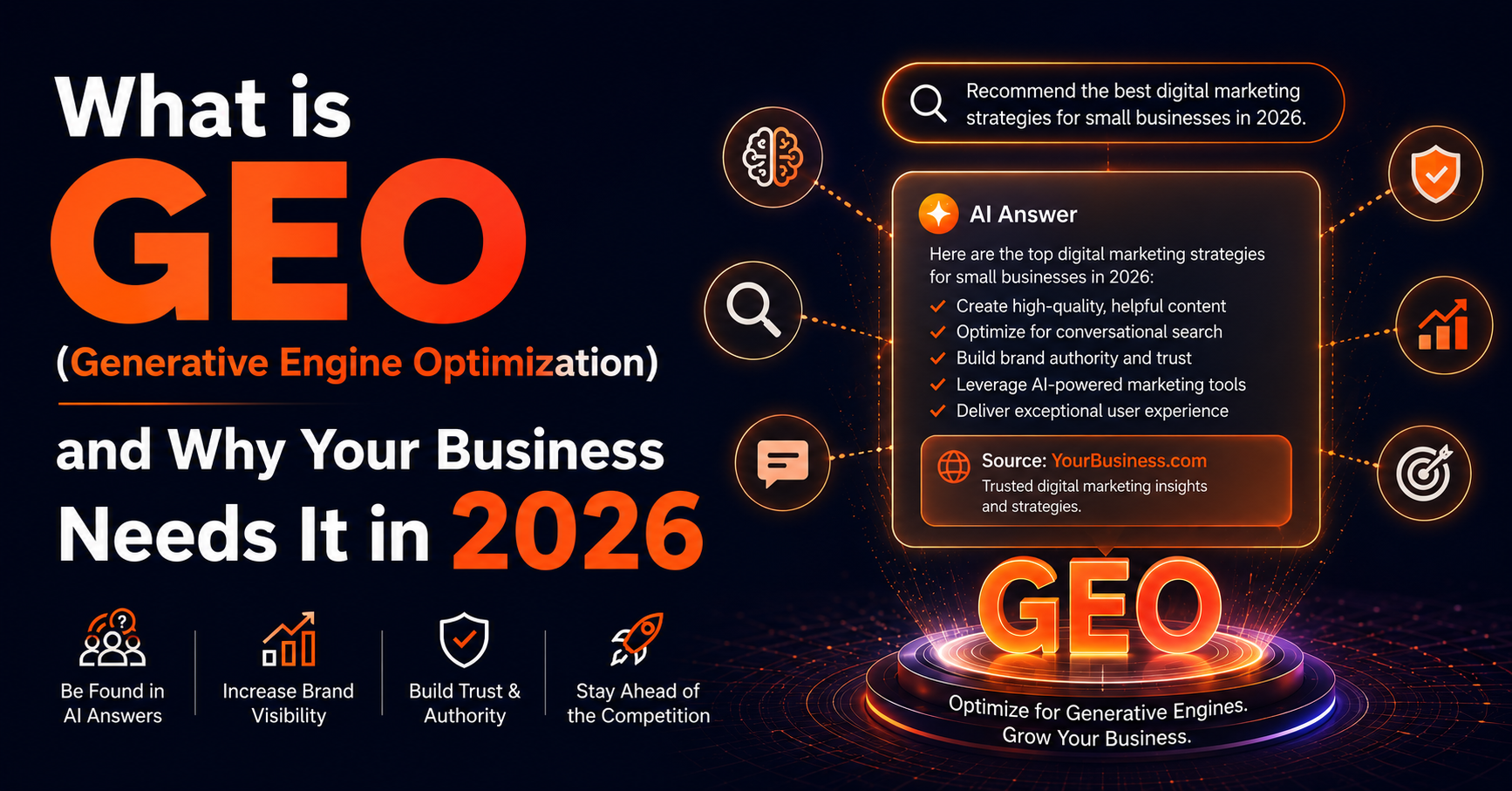
What is GEO (Generative Engine Optimization) and Why Your Business Needs It in 2026
Introduction: The Search Game Has Changed
Think about the last time you Googled something. Did you scroll through ten blue links, or did you read the AI-generated summary at the top and move on?
Most people chose the second option. And that is exactly why generative engine optimization matters so much right now.
Search engines are no longer just matching keywords to pages. Tools like Google’s AI Overviews, ChatGPT, Perplexity, and Gemini are generating direct answers from your content without sending the user to your website at all. If your content is not optimised for these AI systems, your business simply does not show up in the conversation.
GEO is not a trend. It is the new foundation of digital visibility.
What Is Generative Engine Optimization (GEO)?
Generative engine optimization is the process of structuring, writing, and positioning your content so that AI-powered search tools like Google SGE, ChatGPT, Perplexity, and Bing Copilot cite, quote, or surface your brand in their generated responses.
Traditional SEO helps you rank on a results page. GEO helps you become the answer that AI generates.
Here is the simplest way to understand the difference:
SEO asks: “How do I appear on page one of Google?” GEO asks: “How do I become the source AI trusts enough to quote?”
These two goals overlap, but they require different strategies, different content structures, and different thinking about what it means to be visible online.
How Generative Engines Actually Work
Before you optimise for AI, it helps to understand how these tools pull information.
Generative engines do not crawl your page the same way Google’s bot does. They are trained on large datasets and then use live retrieval to find relevant, trustworthy information at the moment of a query. They look for content that is:
Clear and direct in answering a specific question Well-structured with logical headings and sections Backed by credibility signals like author expertise, citations, and brand consistency Written for humans, not stuffed with keywords Updated regularly to reflect current information
If your content checks these boxes, AI tools are far more likely to use it in their responses.
Why GEO Marketing Is a Business Priority in 2026
GEO marketing is what happens when you apply generative engine optimization principles to your wider brand strategy. It is not just about one blog post or one landing page. It is about consistently showing up as a credible, expert source across every AI-generated conversation in your industry.
Here is why businesses across every sector need to take this seriously right now:
AI search traffic is growing fast. Platforms like Perplexity and ChatGPT are handling hundreds of millions of queries every month. Google’s AI Overviews appear on a significant portion of searches in 2026. If AI is answering questions about your industry, and your brand is not cited, a competitor is.
Zero-click searches are increasing. Users are getting answers without visiting websites. The only way to stay relevant is to be the source that gets credited inside those answers.
Trust signals matter more than ever. Generative AI prioritises sources with strong EEAT signals: Experience, Expertise, Authoritativeness, and Trustworthiness. Businesses that have invested in these signals are already winning the GEO race.
Content quality beats content volume. One genuinely helpful, well-structured piece of content will outperform ten thin, keyword-packed articles when it comes to AI citation. This rewards businesses that invest in real expertise
Key GEO Strategies Your Business Should Implement
If you are ready to start optimising for generative search, here is where to focus:
- Build Topic Authority, Not Just Keyword Coverage
Pick your core topics and go deep. Cover every angle. Answer every question. AI tools favour sources that demonstrate comprehensive knowledge on a subject, not sources that touched it once.
- Use Structured, Scannable Content Formats
Clear H2 and H3 headings, short paragraphs, bullet points, FAQs, and definition-style explanations all make it easier for AI to extract and cite your content accurately.
- Write Direct Answers Early
If someone asks “what is generative engine optimization,” your content should answer that in the first two sentences, not after a 300-word introduction. AI tools pull concise, direct answers. Position them prominently.
- Strengthen Your EEAT Signals
Include author bios with real credentials. Cite sources. Add case studies, original data, and real-world examples. Keep your “About” and service pages accurate and well-written. These signals communicate credibility to both AI systems and human readers.
- Optimise for Conversational and Long-Tail Queries
People ask AI tools full questions, not just keywords. Your content should naturally answer questions the way a real expert would speak them.
- Keep Content Fresh and Accurate
AI retrieval systems look at recency and accuracy. Outdated statistics or incorrect information can actually hurt your visibility. Review and update your key content regularly.
- Build Consistent Brand Mentions Across the Web
The more your brand is mentioned in credible, relevant contexts across the internet, the more likely AI tools are to recognise you as a trusted source. PR, guest contributions, partnerships, and social proof all feed into this.
GEO vs SEO: Do You Have to Choose?
No. And any agency that tells you to abandon traditional SEO entirely is giving you bad advice.
SEO and GEO are complementary. A strong SEO foundation, including technical health, backlink authority, fast-loading pages, and well-structured content, supports your GEO strategy. The content that ranks well on Google is often the same content that gets cited by AI tools.
What changes with GEO is the emphasis. You write less for the algorithm and more for the person asking a question. You focus less on keyword density and more on genuine helpfulness. You think less about click-through rates and more about being the most credible voice in a topic area.
In 2026, the best digital marketing strategies treat SEO and GEO as two layers of the same goal: being the most useful, visible, and trusted brand in your space.
Which Businesses Benefit Most from GEO?
Honestly, any business with an online presence should care about GEO. But the impact is especially significant for:
Service businesses in competitive markets (legal, healthcare, finance, real estate, marketing) E-commerce brands in categories where people research before buying B2B companies where buyers are making complex, multi-touch decisions Local businesses trying to appear in AI-generated local recommendations Startups and growing brands trying to build authority quickly
If your target customers are asking questions online, and they are, then GEO marketing is directly relevant to how they find you.
Common GEO Mistakes Businesses Make
Avoid these traps as you build your generative optimization strategy:
Treating GEO as a one-time content project rather than an ongoing strategy Writing content that sounds like it was made for a machine, not a person Ignoring author credibility and EEAT signals on your website Focusing only on short-form content when AI prefers depth and detail Skipping FAQs and structured Q&A formats, which AI tools frequently cite
Final Thoughts: The Businesses That Start Now Will Lead Tomorrow
The shift toward AI-generated search is not coming. It is already here.
Generative engine optimization is how forward-thinking businesses ensure they stay visible, credible, and competitive as search behaviour continues to evolve. It rewards the same things that have always made businesses great: genuine expertise, clear communication, and a real commitment to being helpful.
If your marketing strategy does not yet account for GEO, now is the right time to start. The businesses investing in this today are the ones that will own the AI-generated conversation in their industry tomorrow.
At Mixmedia Labs, we help businesses in Bangalore and across India build digital strategies that are built for how people actually search in 2026, not how they searched five years ago. If you want your brand to show up where it matters, let us talk.