
- Posted on
- admin
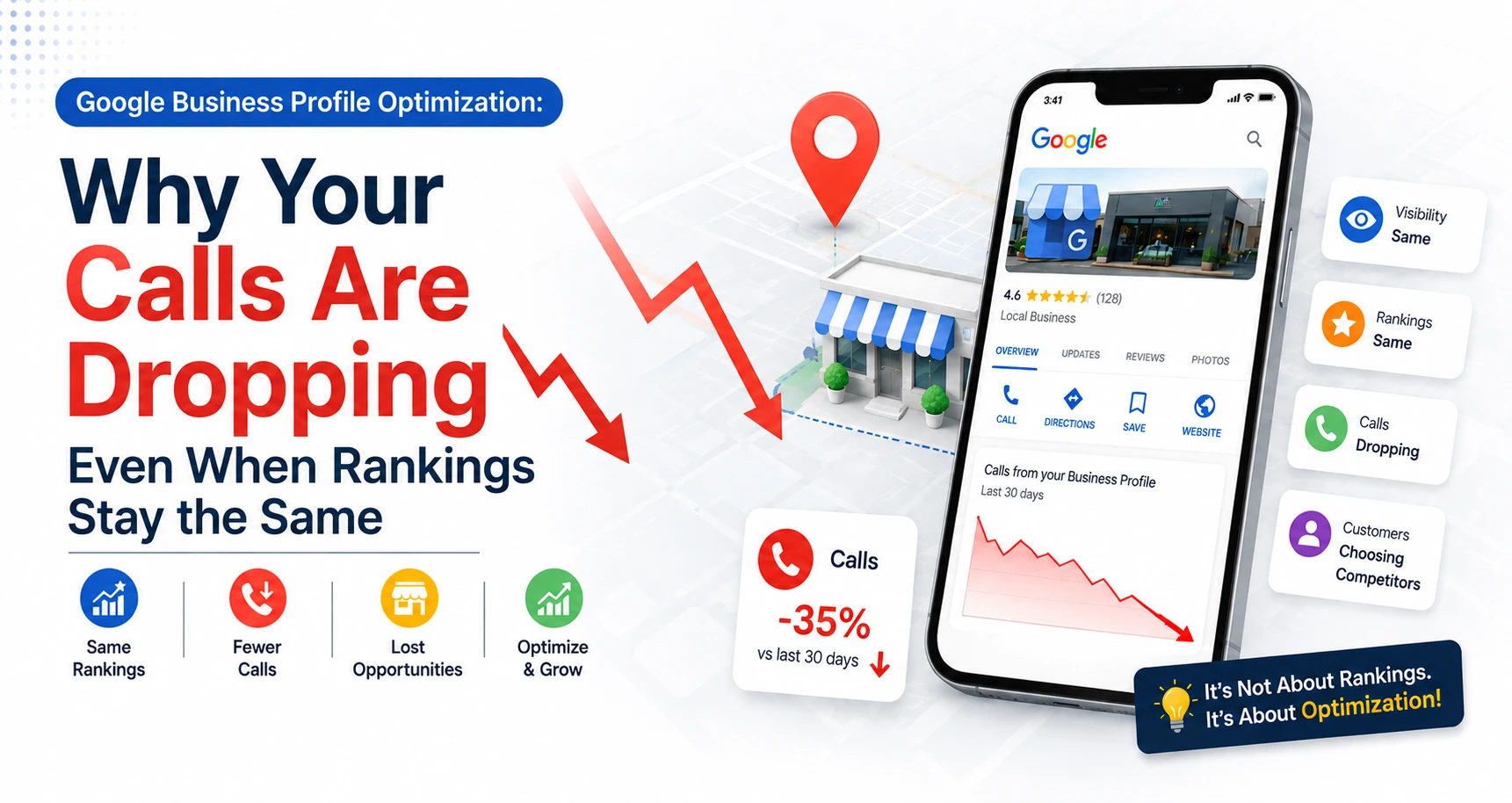
Google Business Profile Optimization: Why Your Calls Are Dropping Even When Rankings Stay the Same
If you check your Google Business Profile every week and your ranking hasn’t moved, but the phone has gone quiet, you are not imagining it. This is one of the most common (and most confusing) problems local business owners bring to us at Mixmedia Labs.
Rankings are just one signal Google shows searchers. What actually drives a call is a mix of trust signals, visual appeal, review freshness, and how “alive” your profile looks compared to competitors sitting right next to you on the map.
Let’s break down what is really happening and how proper Google Business Profile Optimization fixes it.
Google Business Profile Optimization Is Not the Same as Ranking
A lot of business owners treat ranking position as the finish line. It isn’t.
Here’s the reality:
- Ranking tells Google where to place you on the map pack.
- Optimization tells the searcher whether to trust you enough to call.
- You can rank #2 and still lose the click to the business ranked #4, simply because their profile looks more active, more reviewed, and more complete.
Google Maps SEO and traditional local SEO overlap, but they are not identical. Local SEO focuses on your website’s authority and citations. Google Maps SEO focuses almost entirely on profile behavior, engagement, and proximity signals inside the Google ecosystem itself.
Why Calls Drop While Rankings Stay Flat
This is the part most agencies skip over. Here are the real, practical reasons this happens.
- Review recency, not just review count A profile with 200 reviews from two years ago looks less trustworthy today than one with 40 reviews from the last three months. Google and searchers both notice stale activity.
- Photo decay Profiles that haven’t added a new photo in six or more months quietly lose engagement. Searchers scroll photos before they scroll descriptions.
- Missing or outdated Q&A section Unanswered questions on your profile are visible to everyone searching your business name. Competitors with answered Q&A sections look more credible instantly.
- Category drift Google occasionally suggests or auto-applies secondary categories. If your primary category no longer matches your core service, you may still rank, but you attract the wrong intent, and wrong intent does not convert to calls.
- Call tracking mismatch Sometimes it isn’t Google at all. If your call tracking number was recently changed, cached, or flagged as spam by a caller ID app, the drop can look like a ranking issue when it’s actually a phone trust issue.
- Booking or messaging features stealing calls If you enabled Google’s messaging or booking button, some of your “call volume” may simply be shifting into messages you are not tracking as conversions.
Core Google Business Profile Ranking Factors to Revisit
Google has never published an exact formula, but based on consistent pattern testing across client accounts, these factors carry real weight:
- Relevance – how well your profile matches the search intent and category
- Distance – proximity between the searcher and your business location
- Prominence – overall reputation, based on reviews, links, and citations across the web
- Profile completeness – attributes, hours, services, and products filled in fully
- Engagement signals – clicks, calls, direction requests, and photo views over time
- Posting consistency – regular Google Posts signal an active, maintained business
None of these live in isolation. A business that ranks well but ignores engagement signals will slowly lose visibility in the “map pack impressions to actions” ratio Google tracks internally, even if the position number doesn’t change right away.
Local SEO and Google Maps SEO Working Together
Think of it this way:
- Local SEO builds your credibility across the wider web (citations, backlinks, website content).
- Google Maps SEO builds your credibility inside Google’s own ecosystem (profile activity, reviews, photos).
You need both. A strong website with weak profile activity will rank fine but convert poorly. A highly active profile with a weak, thin website will convert well initially but plateau because Google can’t verify authority beyond the profile itself.
A Practical Google Business Profile Optimization Checklist
Use this as a working checklist, not a one-time task.
- Update at least one photo every two to three weeks
- Respond to every review within 48 hours, positive or negative
- Add or update Google Posts weekly, even short ones
- Fill every attribute field relevant to your business
- Audit and correct your primary and secondary categories quarterly
- Answer any open questions in the Q&A section, and seed a few common ones yourself
- Verify your call tracking number is correctly linked and not marked as spam
- Check your NAP (name, address, phone) consistency across directories
- Add services and products with real descriptions, not just names
How to Fix Dropping Calls Without Obsessing Over Rank
Instead of refreshing your rank tracker daily, shift focus to what searchers actually see and do.
- Pull your Google Business Profile insights and compare calls, direction requests, and website clicks month over month, not just search position.
- Look at your “actions taken” ratio compared to your total views. A dropping ratio, even with flat rank, is the real early warning sign.
- Read your last ten reviews carefully. Are customers mentioning confusion, wrong hours, or unclear services? That confusion is costing you calls before the phone even rings.
- Compare your profile visually against your top three competitors. Be honest about which one you would call if you were the customer.
The Bigger Picture
Google Business Profile Optimization is not a checkbox project. It’s an ongoing trust building exercise between your business and every person who searches your category this week. Rankings measure visibility. Optimization measures whether that visibility turns into a conversation with a real customer.
At Mixmedia Labs, we treat every profile audit as a behavior audit first and a ranking audit second, because that’s usually where the real answers are hiding.
If your rankings look fine but your calls don’t match, it’s worth a proper audit before assuming the algorithm changed. More often than not, the algorithm didn’t move. The searcher’s trust did.